
Presidio County Criminal Docket Searches
Your search begins with whatever paper names the court. That may be a notice, citation, bond paper, or cause number. Felonies belong to the 394th District Court of Texas. The Presidio County District Clerk keeps that district file. County-level criminal matters go to the County Clerk. Fine-only cases may land in Justice of the Peace Precinct 1, Precinct 2, Marfa Municipal Court, or Presidio Municipal Court. Stopping at one office can miss a live case sitting elsewhere.
Presidio County offers no anonymous official criminal search of its own. A practical chain starts with iDocket or re:SearchTX, then turns to the right clerk for confirmation. iDocket is an independent vendor, not the clerk's agent. Its coverage, images, and the newest event can vary. So treat it as a lead rather than the last word.
- Write down the full name, cause number, court, and approximate filing date.
- Choose the district, county, JP, or city court before searching.
- Match the case caption and court number.
- Read settings, motions, pleas, and disposition as separate events.
- Request the docket or certified document from the clerk when proof is needed.
Presidio Criminal Search Fallbacks
When an online record is missing or stale, go straight to the office that holds the file. The District Clerk answers at (432) 729-3857. The fax line is (432) 729-4313, and the email is carolina.catano@co.presidio.tx.us. The mailing address is P.O. Box 789, Marfa, Texas 79843. District records sit on the first floor. The address is 300 N. Highland Avenue in Marfa. The County Clerk sits at the same site and answers at (432) 729-4812.
For the justice courts, JP1 uses (432) 729-4831 and jp1presidioco@co.presidio.tx.us, while JP2 uses (432) 229-3705 and justiceofthepeacepct2@co.presidio.tx.us. City cases belong to the municipal clerk. The 394th coordinator in Alpine handles settings and rooms. Filings and copies stay with the District Clerk. The clerk's office posts no public terminal or drop box. A written request should name the court, cause, record, date range, copy type, and delivery method. If the court level is unclear, the Presidio County docket search route sorts it out.
Criminal Dockets: What They Show
A criminal docket lists events in time order. That is all it is. It proves a filing, not what the paper says. An entry may note an indictment, motion, order, or judgment without showing its text. A charge is only an accusation, and a hearing line rarely captures all that happened there. When a short label leaves doubt, read the signed judgment or order, because that document controls.
| Cause number | The court identifier; the exact local format was not verified from a safe public sample. |
|---|---|
| Charge | The alleged offense, charging paper, and statute when public. |
| Bond event | Amount, type, conditions, or magistrate action where public. |
| Setting | Arraignment, pretrial, plea, trial, or other date and status. |
| Disposition | Dismissal, plea, trial result, sentence, or other outcome. |
| Appeal | Notice, appellate cause, record preparation, or mandate. |
Copy a case number exactly as the clerk wrote it. No local pattern is published here, so never guess at a criminal cause number.
Presidio Criminal Docket Proof Limits
Single lines can mislead. An indictment means a grand jury charged an offense, nothing more. A motion merely asks for action; an order records the judge's direction. A disposed case is not automatically sealed or expunged. A dismissal may cover one charge while other counts live on. These distinctions matter whether you track your own matter. They also matter for a public case in Presidio County.
- Arraignment
- An event at which the charge and plea are addressed.
- Setting
- A scheduled event that may later be reset.
- Disposition
- The result or status entered for a case or charge.
- Expunction
- A process that can remove eligible records from public access.
- Non-disclosure
- An order limiting release, distinct from expunction.
If a summary and the filed judgment disagree, order the document itself from the clerk. Vendor data and OCA reports can point you to a court or measure workload, but neither certifies the case record.
Criminal Case Stages on the Docket
A district felony often starts small, with magistrate or bond events. District entries surface only later. Then comes the charging paper, counsel appearances, arraignment, discovery, motions, and pretrial settings. A plea or trial may settle the case. Sentencing and later post-judgment events can follow. An appeal adds its own trail: a notice, clerk's record, appellate cause, and mandate.
Docket flow: Filing › Arraignment › Pretrial › Plea or Trial › Disposition › Sentencing
Not every Presidio County case uses each step. A reset moves a setting and leaves the charge untouched. Check the next date with the notice, clerk, or coordinator. The 394th travels across five counties. Its Alpine office does not mean every Presidio County hearing happens there.
The Presidio 394th Felony Docket
The 394th District Court is the general-jurisdiction trial court for Presidio County felonies. It serves four other counties as well. District Clerk Carolina Catano in Marfa keeps the file. It covers the docket, indictment, motions, orders, judgment, certification, and appellate record. The judge and coordinator in Alpine handle scheduling and court procedure.
Looking for local rules, forms, and standing orders? The Texas local rules repository offers search fields by court and county.
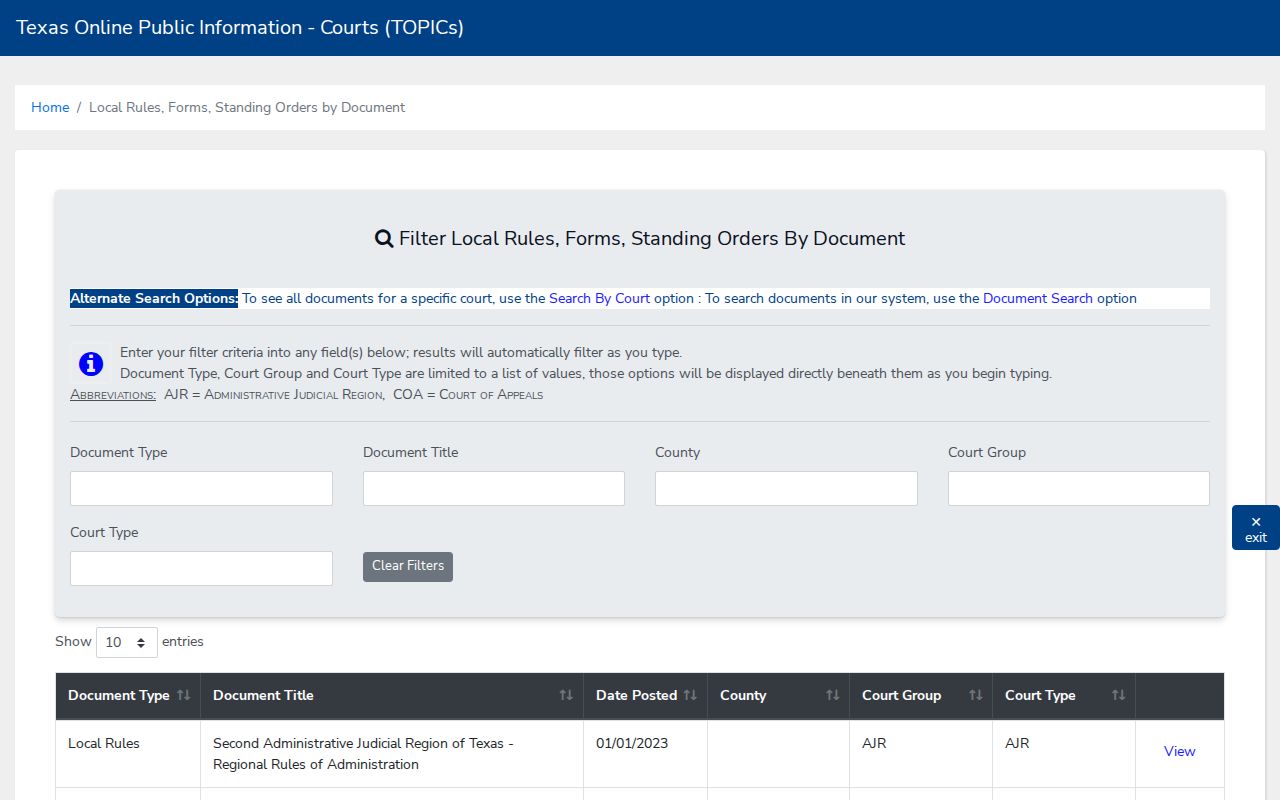
A rule search and a case search answer different questions. The docket tracks the cause, while local orders govern the procedure that may shape a setting or filing.
Presidio County Criminal Docket Courts
Felonies route to the 394th. The constitutional County Court handles county criminal jurisdiction within state limits. Justice courts hear fine-only offenses under Article 4.11. Municipal courts take city ordinance and fine-only state cases from inside Marfa or Presidio.
| Court | Matter | Custodian |
|---|---|---|
| 394th District Court | Felony cases | District Clerk |
| County Court | County criminal cases | County Clerk |
| JP1 or JP2 | Fine-only county cases | Precinct office |
| Municipal court | City ordinance and fine-only cases | City court clerk |
The citation itself gives the best clues: match the issuing agency and court, not where a person lives. A payment screen may leave out the charge, hearing history, and result.
Presidio Criminal Filing Freshness
Check dates on any online coverage. The vendor's last-filed page reports dates by category and warns users to verify its data.
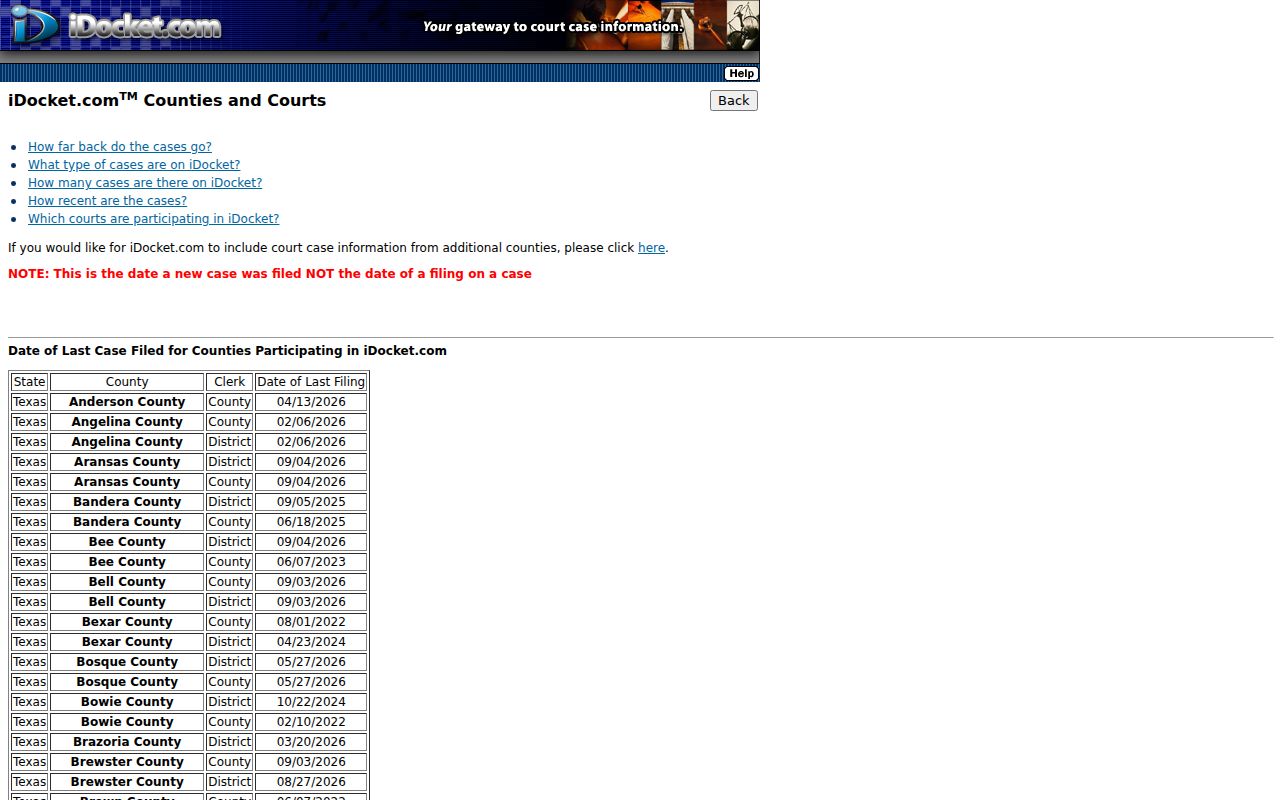
That page helps you test whether a missing recent event reflects lag. It cannot certify that a case is complete, current, public, or absent. If a date looks old, ask the clerk. Ask for the current docket and the exact document. For bulk data, seek official terms from the custodian of the court records.
Access Rules for Criminal Dockets
Criminal court dockets in Presidio County don't travel the usual Texas Public Information Act lane. Government Code Section 552.0035 hands judicial records to court rules and other law instead. Rule 12 lets you inspect and copy files during regular hours. That holds unless an exemption applies. Some filed case records answer to their own statute or order, so check that too.
Key rules:
Judicial Administration Rule 12 governs judicial-record access and exemptions.
Family Code Chapter 58 restricts juvenile records.
Criminal Procedure Chapter 55A governs expunction.
Rule 21c keeps sensitive data out of view. Sealing, expunction, and non-disclosure are three different things, and a missing result can mean many things: a spelling slip, the wrong court, thin coverage, a legal restriction, or plain lag. Ask the clerk whether the limit is legal, order-based, or technical, and which authorized route fits your case lookup.
Presidio Criminal Docket Requests
A tight request gets faster results. Name the court, the cause number, the event or document, and the date range. Say whether you want a plain or certified copy. Pick a delivery method, and ask for a quote. If the clerk limits access, ask why. Request the rule, statute, or order behind that limit. Also ask how to seek review.
Presidio County's expunction procedure asks applicants to do two things. Name the right magistrate. Notice the proper agencies. The procedure mentions email notice and a mailed-notice charge, though current costs must be confirmed. It is not a general docket form. Counsel requests also go through the 394th application process, not a public docket search.
Tie any Rule 12 request to a record that already exists. The clerk's office does not have to build a new report. Nor must it compile data no one ever filed.